Read Our Blogs

Manual vs Automated Trading Signals: Which One Is Right for You?
In today's fast-paced financial markets, trading signals have become an essential tool for traders looking to identify profitable opportunities. Whether you're trading Forex, cryptocurrencies, commodities, or stocks, signals can help simplify decision-making and improve trading efficiency. However, traders often face a common question: Should you use manual trading signals or automated trading signals?
Understanding the differences between these two approaches can help you choose the solution that best aligns with your trading style, goals, and experience level.
What Are Manual Trading Signals?
Manual trading signals are created by experienced traders or market analysts who carefully study price action, technical indicators, market sentiment, and economic news before issuing recommendations.
- Key Features of Manual Signals
- Generated by human expertise
- Based on technical and fundamental analysis
- Can adapt to unexpected market events
- Often include detailed market explanations
Advantages of Manual Trading Signals
- Human judgment and market experience
- Better interpretation of news events and economic releases
- Flexible decision-making during volatile market conditions
- Additional educational insights for traders
Disadvantages of Manual Trading Signals
- Slower signal delivery
- Potential for human error
- Limited availability during certain trading hours
- Results may vary depending on analyst expertise
What Are Automated Trading Signals?
- Slower signal delivery
- Potential for human error
- Limited availability during certain trading hours
- Results may vary depending on analyst expertise
What Are Automated Trading Signals?
Automated trading signals are generated by sophisticated algorithms and trading software that continuously monitor market conditions and identify trading opportunities based on predefined rules.
- Key Features of Automated Signals
- Generated by computer algorithms
- Operate 24/7 without interruption
- Execute trades instantly
- Remove emotional decision-making
Advantages of Automated Trading Signals
- Fast signal generation and execution
- Consistent analysis methodology
- Ability to monitor multiple markets simultaneously
- No emotional bias or fatigue
Disadvantages of Automated Trading Signals
- Limited ability to interpret unexpected news events
- Dependence on historical data and programmed rules
- Potential technical failures
- May struggle during unusual market conditions
Best Practice: Combining Manual and Automated Signals
- Limited ability to interpret unexpected news events
- Dependence on historical data and programmed rules
- Potential technical failures
- May struggle during unusual market conditions
Best Practice: Combining Manual and Automated Signals
Many professional traders use a hybrid approach:
- Use Automated Signals For:
- Quick market scanning
- High-frequency opportunities
- Multi-market monitoring
- Use Manual Analysis For:
- Confirming trade setups
- Evaluating major news events
- Risk management decisions
- Long-term market direction
This combination allows traders to benefit from both speed and human expertise.
Final Thoughts
Both manual and automated trading signals offer valuable advantages. Manual signals provide human insight, adaptability, and educational value, while automated signals deliver speed, consistency, and around-the-clock market monitoring.
Rather than viewing them as competitors, many successful traders use them together to create a balanced and effective trading strategy. The right choice ultimately depends on your trading goals, experience level, and preferred approach to the financial markets.
Grow Your Trading Signal with EFD Group
Best Wishes
EFD Group
Division | Trading Signal Service
Why Professional Traders Still Use Trading Signals?
In today’s fast-moving financial markets, professional traders rely on more than just instinct and experience to make profitable decisions. Whether trading forex, stocks, commodities, or cryptocurrencies, market conditions can change within seconds. This is why trading signals continue to play a major role in professional trading strategies. Trading signals provide traders with real-time insights, technical analysis, and market opportunities that help improve decision-making and reduce emotional trading.
While many beginners think trading signals are only useful for new traders, the reality is that even experienced investors and institutional traders use advanced trading signal systems to monitor trends, identify entry and exit points, and manage risks effectively. In competitive markets where timing matters, trading signals help professionals stay ahead by combining market data, indicators, and analysis into actionable trading opportunities.
What Are Trading Signals?
Trading signals are market recommendations or alerts that suggest when to buy or sell a financial asset. These signals are generated through technical analysis, market indicators, price action, algorithms, or professional analyst research. Signals can be sent through mobile apps, email notifications, Telegram channels, trading platforms, or SMS alerts.
- A trading signal usually includes:
- Entry price
- Stop-loss level
- Take-profit target
- Market direction (buy or sell)
- Timeframe for the trade
Professional traders use these signals as part of their trading strategy to improve accuracy and efficiency.
Why Professional Traders Trust Trading Signals
1. Faster Market Analysis
Financial markets move extremely fast, especially in forex and cryptocurrency trading. Monitoring multiple charts, indicators, and economic news manually can be difficult even for experienced traders.
- Trading signals help professionals:
- Save analysis time
- Identify opportunities instantly
- React quickly to market movements
- Track multiple assets simultaneously
This speed allows traders to execute trades before opportunities disappear.
2. Reduced Emotional Trading
One of the biggest challenges in trading is controlling emotions. Fear, greed, panic, and overconfidence often lead to poor decisions and unnecessary losses.Professional traders use trading signals because they provide structured and data-driven decisions instead of emotional reactions. Signals help traders follow predefined strategies and maintain discipline in volatile markets.
- Benefits include:
- Better risk management
- Consistent trading behavior
- Reduced impulsive trades
- Improved long-term performance
Benefits of Trading Signals for Professional Traders
Better Time Management
Professional traders cannot monitor charts 24 hours a day. Signals allow them to focus only on high-probability setups instead of continuously watching the market.
Learning and Skill Improvement
Many professionals also use trading signals to validate their own analysis and improve their market understanding over time.
Consistent Strategy Execution
Using trading signals helps traders stick to a structured strategy instead of making random decisions.
Increased Trading Opportunities
Signals help traders identify opportunities across different markets and timeframes that might otherwise be missed.
How Professional Traders Choose Reliable Trading Signals
- Not all trading signals are accurate or trustworthy. Professional traders usually evaluate signal providers based on:
- Historical performance
- Accuracy rate
- Transparency
- Risk management strategy
- Market expertise
- Real-time delivery speed
- User reviews and reputation
Reliable trading signal providers focus on consistency rather than unrealistic profit promises.
The Future of Trading Signals
Trading signals continue to evolve with technology. Artificial intelligence, machine learning, big data analytics, and automated trading systems are transforming how professional traders analyze markets.
- Future trading signal systems may include:
- Advanced AI predictions
- Personalized trading strategies
- Automated portfolio management
- Smart risk assessment tools
- Real-time global market sentiment analysis
As financial markets become more competitive, trading signals will likely remain an essential part of professional trading.
Conclusion
Professional traders still use trading signals because they provide speed, accuracy, efficiency, and structured market analysis. In highly competitive markets, trading signals help traders identify opportunities faster, reduce emotional decisions, and improve overall trading performance.
Whether used for forex trading, stock trading, cryptocurrency investing, or commodities, reliable trading signals can support better decision-making and stronger risk management. While signals are not a guarantee of success, they remain a valuable tool that helps professional traders navigate complex financial markets with greater confidence and discipline.
Grow Your Trading Signal with EFD Group
Best Wishes
EFD Group
Division | Trading Signal Service
Top 10 Forex Trading Terms Every Beginner Must Know
Introduction: Start Smart in Forex Trading
Entering the Forex market without understanding basic terminology is like driving without knowing traffic rules. The foreign exchange market is fast-paced and highly dynamic, and mastering key terms is the first step toward becoming a confident and profitable trader.
At EFD Forex, we believe that strong fundamentals build strong traders. Here are the top 10 essential Forex trading terms every beginner must know.
1. Currency Pair
- Forex trading always involves two currencies:
- Base Currency (first currency)
- Quote Currency (second currency)
Example: EUR/USD
You are buying Euros and selling US Dollars
2. Pip (Percentage in Point)
- A pip is the smallest price movement in a currency pair.
- Typically the 4th decimal place (0.0001)
- Example: EUR/USD moves from 1.1000 → 1.1001 = 1 pip
This is how profit and loss are measured.
3. Lot Size
- A lot defines the size of your trade:
- Standard Lot = 100,000 units
- Mini Lot = 10,000 units
- Micro Lot = 1,000 units
Larger lot size = higher risk and reward.
4. Leverage
Leverage allows traders to control larger positions with smaller capital.
- Example:
- 1:100 leverage → ₹1,000 can control ₹1,00,000
While leverage increases profit potential, it also increases risk significantly.
5. Bullish & Bearish Market
- Bullish Market → Prices are rising
- Bearish Market → Prices are falling
Understanding market direction is key to making correct trades.
6. Volatility
Volatility refers to how fast and how much the market moves.
- High volatility = more opportunities (and risk)
- Low volatility = stable but slower movement
Successful traders adapt their strategy based on volatility.
Conclusion
Forex trading can be highly rewarding—but only if you understand the language of the market. These 10 terms form the foundation of your trading journey.At EFD Forex, we empower beginners with the right knowledge and structured approach to succeed in Forex trading.
Call to Action
Ready to start your forex journey the right way?
Explore beginner-friendly strategies and expert guidance with EFD Forex today.
Grow Your Trading Signal with EFD Group
Best Wishes
EFD Group
Division | Trading Signal Service

Trend Following Strategy: A Professional Guide to Identifying Market Direction
In financial markets, consistency is rarely achieved through prediction alone. Instead, it is built on disciplined execution and alignment with prevailing market forces. One of the most effective approaches that reflects this principle is the trend following strategy.
Rather than attempting to forecast market reversals, trend following focuses on identifying and participating in sustained price movements — a method widely used by institutional and professional traders.
Understanding Market Trends
A trend represents the directional movement of price over a defined period, driven by an imbalance between supply and demand.
- There are three primary market conditions:
- Uptrend: Characterized by higher highs and higher lows, indicating sustained buying pressure.
- Downtrend: Defined by lower highs and lower lows, reflecting consistent selling pressure.
- Sideways Market: A consolidation phase where price lacks clear direction, often resulting in reduced trading opportunities.
Recognizing these conditions is fundamental before applying any trading strategy.
Identifying Market Direction with Precision
Professional traders rely on a structured approach to determine trend direction. Key methods include:
1. Market Structure Analysis
- Price structure provides the clearest indication of trend direction:
- Lower highs and lower lows confirm bearish momentum
- Higher highs and higher lows confirm bullish momentum
- Price above key averages (e.g., 50 EMA and 200 EMA) suggests an uptrend
- Price below these levels indicates a downtrend
- In an uptrend, previous resistance levels tend to act as support
- In a downtrend, previous support levels often become resistance
- Step 1: Identify the overall trend using market structure and moving averages
- Step 2: Wait for a retracement toward a key level (moving average or support/resistance)
- Step 3: Enter in the direction of the trend upon confirmation (e.g., strong rejection candle)
- Step 4: Place a stop-loss beyond the recent swing high/low
- Step 5: Manage the position by trailing stops as the trend develops
- Adhere strictly to predefined trading rules
- Avoid trading during uncertain or low-volatility conditions
- Maintain a favourable risk-to-reward ratio (minimum 1:2)
- Limit exposure to 1–2% of capital per trade
- Enables participation in extended market moves
- Applicable across forex, commodities, and equities
- Reduces emotional decision-making
- Aligns with dominant market direction
This approach eliminates reliance on lagging indicators and focuses on real-time price behaviour.
2. Moving Average Alignment
- Moving averages help filter noise and confirm trend strength.
The alignment of shorter-term and longer-term averages provides additional confirmation.
3. Support and Resistance Levels
- Institutional trading activity is often concentrated around key price zones.
These levels offer high-probability entry points within the trend.
4. Momentum Confirmation
Indicators such as RSI and MACD are used to validate the strength of a trend rather than generate signals independently.They help assess whether the trend has sufficient momentum to continue.
Structured Trend Following Strategy
- A disciplined framework ensures consistency in execution:
This approach emphasizes patience and precision over impulsive trading.
Risk Management Considerations
- Even the most reliable strategies require robust risk control:
Risk management is not optional — it is the foundation of long-term sustainability.
Advantages of Trend Following
Conclusion
Trend following remains one of the most robust and time-tested trading methodologies. By focusing on market structure, confirmation, and disciplined execution, traders can improve both accuracy and consistency.
In professional trading, success is not defined by predicting every market move, but by consistently positioning in alignment with the prevailing trend.
Grow Your Trading Signal with EFD Group
Best Wishes
EFD Group
Division | Trading Signal Service
Stop Loss & Take Profit: Smart Usage Guide (Complete Forex Trading Guide)
In Forex trading, long-term success depends not just on accurate entries, but on how effectively a trader manages exits. Stop Loss (SL) and Take Profit (TP) are essential tools that help control risk, protect capital, and secure profits in a disciplined and systematic way. Traders who consistently apply these tools tend to survive market volatility and build sustainable growth, while those who ignore them often face unpredictable losses.
Understanding Stop Loss
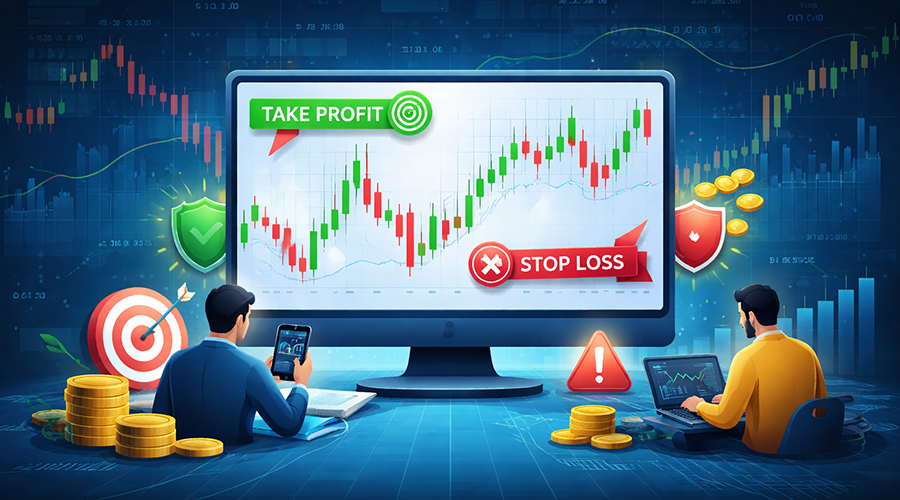
A Stop Loss is a predefined level set by the trader to automatically close a position when the market moves against them. Its primary purpose is to limit potential losses and prevent emotional decision-making during unfavorable market movements.Using Stop Loss ensures that no single trade can significantly damage your trading account. It acts as a safety mechanism that enforces discipline and prevents overexposure to risk.
Understanding Take Profit
A Take Profit is a predetermined price level at which a trade is automatically closed once a desired profit target is reached. It helps traders lock in gains without relying on manual intervention.Take Profit removes the influence of greed and hesitation, allowing traders to follow a structured plan rather than reacting emotionally to market fluctuations.
Importance of Stop Loss & Take Profit in Trading
1. Capital Protection
The primary goal of any trader is to protect capital. Stop Loss ensures losses are controlled and manageable.
2. Ignoring Risk Management
Trading decisions driven by fear or greed often lead to poor outcomes. SL and TP enforce discipline.
3. Overtrading Due to Signal Overload
Predefined exit levels help maintain a consistent trading approach over time.
4. Emotional Trading & Deviating From the Plan
Trades are executed automatically at predefined levels, reducing the need for constant monitoring.
Effective Take Profit Strategies
1. Key Level Targeting
Take Profit should be aligned with important price levels where the market is likely to react.
2. Risk-Reward Alignment
Profit targets should always justify the risk taken, maintaining a balanced and strategic approach.
3. Trend Continuation Approach
In strong trends, traders may allow profits to run while adjusting targets dynamically.
4. Structured Exit Planning
Having a clear exit plan before entering a trade ensures consistency and reduces impulsive decisions.
Common Mistakes Traders Must Avoid
Conclusion
Stop Loss and Take Profit are fundamental tools that define a trader’s risk management system. They are not optional—they are essential for maintaining control, reducing emotional trading, and achieving long-term consistency.Successful traders focus on protecting capital first and growing profits second. By applying Stop Loss and Take Profit strategically, traders can navigate the Forex market with confidence, discipline, and a clear plan.